
Roderick Campbell Mathieson left New Zealand before WW2 had started to join the Royal Air Force, and though he never saw action he died in an accident while on active service.
Known as Roy to his family, he was born in Wellington in 1917, the youngest son of Isaac Harper Mathieson and Mary Campbell. Isaac had arrived in New Zealand from Scotland aged about 5 or 6, with his parents John and Isabella (née Harper) Mathieson and no fewer than 10 siblings.
The family settled in Southland, and in time Isaac joined the Police. In 1906 he married Mary Campbell, who was born in New Zealand to Scottish immigrant parents. Isaac’s job saw the family living in many different parts of the country. They had five children in total, with Roy being the youngest.

Roy was educated in Timaru, and moved to Wellington where he worked in a radio factory. He was in the territorial air force (and also played in the RNZAF band) from late 1936 to early 1937. After being selected for a short service commission (usually 12 years) in the RAF, he embarked for the UK in April 1938.
There he trained as a pilot, gaining his wings in October 1938. In early 1939, before the outbreak of war, he was assigned to No. 1 Anti Aircraft Cooperation Unit, where he flew various types of aircraft.
Anti-aircraft cooperation units provided aerial targets for anti-aircraft artillery units to practise on. That might sound dodgy, but oddly enough it wasn’t being hit by ground fire that was riskiest for Roy — rather, it was the type of aircraft he flew.
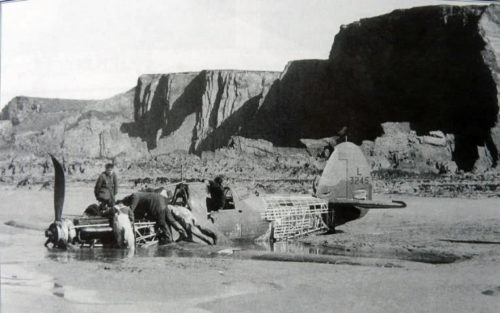
The Henley was a specialist target-towing aircraft derived from the Hawker Hurricane, but a combination of slow speed and high engine power meant it suffered from frequent engine failure. And that’s what happened on 1 April 1940.
Roy and his target winch operator took off in a Henley from RAF Cleave, near Bude in Cornwall. Just a mile north of Bude the single engine failed and the plane ditched in heavy seas only 50 m offshore. Both crew escaped from the sinking machine, but were drowned in heavy surf.
He was buried in St John the Baptist churchyard at Morwenstow, 10 km north of Bude. In the adjacent grave is AC1 Edward John Robinson, an 18-year-old Canadian who was the crew member on that last flight. The pair were buried with full military honours. A contemporary account of the well-attended funeral describes how the caskets were conveyed to the church on a gun carriage, members of the RAF acted as pallbearers, and there was a firing party and bugler at the graveside.

(Photo: New Zealand War Graves Project)