
Research on Mathesons who served in the New Zealand forces during the First World War has identified Mathesons from New Zealand who fought in this conflict in other forces. As New Zealand was part of the British empire it was not at all unusual for New Zealanders to enlist in other imperial forces. This article doesn’t attempt to include all Mathesons with a New Zealand connection who served in other countries’ forces, as this would be a huge job. But those I’ve come across are noted here for interest.
MATHESON, Ewen Mason
British Army regimental numbers 26107 and 241867.
Ewen, known as Eudie, Matheson was from Bunnythorpe and Palmerston North where he worked as a builder and was involved in the volunteer force the Palmerston Guards. Like his brother Stewart Farquhar Matheson he went to the USA for a time then, when the First World War broke out, travelled to the UK to join up.
He joined the 13th Royal Scots battalion and served in France where he was severely wounded. After recovery he transferred to the famous Black Watch regiment and served in England as an instructor, gaining recognition for his musketry and marksmanship.
Later he transferred to another Scottish regiment, the Gordon Highlanders, from where he was attached to the 4th Battalion of the 4th Regiment (Uganda) of the Kings African Rifles (4/4 KAR) and sent to fight in southern Africa. What is now Tanzania was then German East Africa, and German troops spilled south into what is now Mozambique (then Portuguese East Africa) and fought British forces.
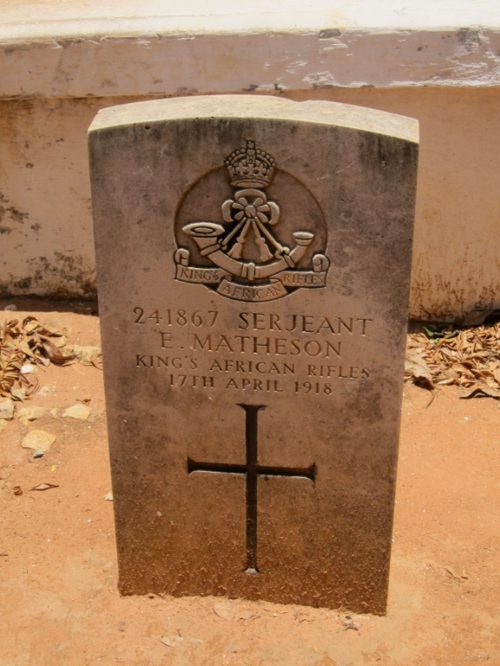
In 1918 from their base in Port Amelia (now named Pemba) 4/4 KAR advanced on German positions. During April 1918 the battalion was engaged in fierce fighting, and on 17 April near Kinjiri River Sergeant Ewen Matheson was one of the casualties. His body was buried in Pemba cemetery.
MATHESON, Harry MacKay
Though Harry Matheson served in the Australian and British armies, he has a New Zealand connection. When he enlisted in 1914 his next of kin was listed as his father, Angus Kenneth Matheson of Auckland. From his military record it can be gleaned that Harry was born out of wedlock, and his mother (Annie MacKay) later married and as Annie Smith lived in Thames.
Harry was born in Tangil, near Maffra in Victoria, Australia, and when he joined up at the age of 28 he was working as a chemist in Maffra. He joined the Australian Imperial Force and was quickly promoted to corporal, and served as a soldier at Gallipoli. He served in the Somme before transferring in 1916 to the (British) Royal Flying Corps, and was discharged from the Australian forces when he was commissioned as an RFC officer in 1917.
As an RFC officer he was attached to 67 Squadron in the Australian Flying Corps in Palestine, where he died later that year. Harry perished in unusual circumstances, being caught in a fierce storm on Christmas eve 1917 while escorting two visiting officers back to their squadron nearby. The entire camp spent much of Christmas day searching for him, and his body was found on Boxing Day.
Harry’s family background was a little complicated. One William Stredwick of Benalla in Victoria was noted in his files as being a foster father (undeclared), and he and his wife corresponded vigorously with the military authorities over the return of Harry’s personal effects. In letters Stredwick described Harry as his “adopted son”, and he certainly was the beneficiary of Harry’s will. The military wrote to Harry’s mother offering the medals to her, but there appears to have been no reply and they were passed to William Stredwick. There were Matheson connections in Victoria, though, with a Mrs R D Matheson of Sale, near Maffra, describing herself as Harry’s sister-in-law when writing for further information about his fate.
MATHESON, Ronald Tracey

The Auckland Weekly News has this photo of a Lieutenant R Matheson, who died in action in German Southwest Africa (now Namibia). Research has shown that Lt R T Matheson was killed on 27 April 1915 while serving in the Natal Light Horse regiment. He was buried in the Gibeon Station military cemetery, which contains South African and German dead from the battle of Gibeon on 27 April 1915.
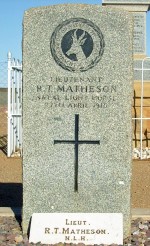
Though he was serving with a South African unit, there must have been a New Zealand connection for him to have featured in the Auckland Weekly News. And indeed there is. Ronald Tracey Matheson was born in Tauranga in 1874 to Otumoetai farmers Robert and Sarah Matheson. Ronald was a mining agent and an veteran of the Anglo-Boer (or South African) War, when he was mentioned in dispatches. During the First World War he was a lieutenant in the Union Forces of South Africa. Ronald was the uncle of Tauranga historian Alister Hugh Matheson (1925–2011) and brother of Alister’s father (also Alister Hugh Matheson), who served in the First World War (75110) and the South African War.
MATHESON, Stewart Farquhar
British Army regimental number 67106. Brother of Ewen Mason Matheson.
After working as in the building industry in the USA in 1914, Stewart travelled to the UK where he enlisted in the Royal Engineers in the British Army. He served in France from mid 1915 until early 1917 when he was wounded and evacuated to England. At that time he was also awarded the Military Medal.
Stewart had worked his way up through the non-commissioned officer ranks, and after recovering from his wounds he trained to be an officer and in 1918 was commissioned as a Second Lieutenant. He was sent to British India in September 1918 where he took part in Afghan fighting, being attached to the 1st King George’s Own Sappers and Miners of the Indian Army, before being repatriated back to New Zealand at the end of the year.
By about 1920 he took up a block of land at Putere near Wairoa. A local history records that “Stewart Matheson (Matt) was the son of a farmer from Bunnythorpe, but was a bridge building engineer prior to the war. He had little farming experience but unlike most of the other settlers he accepted the harsh living conditions and finally made a go of it – the only original to do so. He remained a bachelor all his life.”
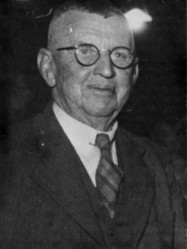
After being injured in a car accident in 1958 Stewart retired to town where he died 5 years later.
MATHIESON, Kenneth

He had farmed near Marton in the Rangitikei for some years, having emigrated to New Zealand largely for health reasons. At the outbreak of war he had been back in Britain for about a year. A former officer, he re-enlisted in the British Army and was killed in the early stages of the conflict.
MATHIESON, Thomas Alexander
This T A Mathieson, from Granity, died in action in 1918. He’s not listed in the New Zealand Cenotaph database, nor does Archives New Zealand hold a file for him, because he was serving in a British regiment.

Thomas Alexander Matheson was born at Waimangaroa, just north of Wesport, on 24 February 1887, the son of Robert Mathieson and Susannah (Susan) White. He was already in the UK before the First World War broke out, and had enlisted in the British Army at Sheffield in March 1910. He married Sarah Park in Ayr, Scotland, on 14 November 1913.
He was a 2nd Corporal in the Royal Engineers (106th Field Company) when he was killed in action at Neuve Eglise in Belgium on 17 April 1918. This village (now known as Nieuwkerke), near Ypres/Ieper, was being fought over again as part of the German spring offensive of 1918.
Photo: Auckland Weekly News 22 August 1918.
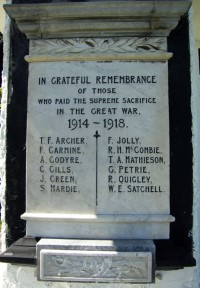
T A Mathieson is commemorated on the war memorial in Granity, on the West Coast, and also on the Tyne Cot memorial to the missing in Belgium. Thanks to Zelda Matheson and the resources of the Westport Genealogy and History Group for information about him.