Born in Glasgow in 1885, son of Donald Matheson and Christina Macpherson. He enlisted on 9 August 1914, very early in the First World War, as shown by his low regimental number. At that point he was living in Wellington with his brother, Dr Farquhar Matheson, and working as a stock auctioneer for Dalgety.

William took part in New Zealand’s first military action of the war, occupying German-administered Western Samoa, and just six days after enlisting he left New Zealand on a ship as part of the Samoan Expeditionary Force. He had joined the 5th Wellington Regiment as a Sergeant as he had six year’s experience in the 5th volunteer battalion, Highland Light Infantry, in Glasgow.
(Photo from Onward: portraits of the New Zealand Expeditionary Force)
In a letter written in 1976 William described his role in 1914 as “filling the various Civil Service jobs that the German officials refused to do under our Flag. I was Chinese Commissioner in charge of everything to do with the 2400 Chinese labourers who had been imported by the Germans”.
Conditions were tough. “We didn’t get any salary and had to live on our own funds ex NZ, with rations we drew from the camp and we had a Chinese prisoner ex the gaol as our cook. He did his cooking in the backyard over a wee fire in the open, and used a fan to help the blaze. My bed was a packing case with my Army overcoat as a mattress. No mosquito net and I was so bitten that I became immune, but a family, Hellesoe, across the road took pity on us and Christine a half caste Samoan made us proper mosquito nets”.
The military occupation force remained in Samoa until early 1915. “When our boys left in [19]15 some of us got restless and turned in our jobs and returned to N.Z. where we re-enlisted. I was sent for by the Min of Defence, Sir James Allen and requested to return to Apia in charge of the big German firm the DH & PG and act as Receiver, which I did at his asking and so landed back in Apia”.
William worked for the Imperial (British) government as a liquidator or receiver of the big trading company ‘German Trading and Plantation Company of the South Sea Islands of Hamburg’, known by its German acronym DH&PG. His role was associated with the administration or sequestration of German assets in Samoa.
This began a long family connection with the Pacific Islands. William’s brother Farquhar left his medical practice in Fairlie in 1920 to move to Samoa, and after some time back in New Zealand worked first in the Cook Islands and then for a long time in Tonga, where he died in 1967.
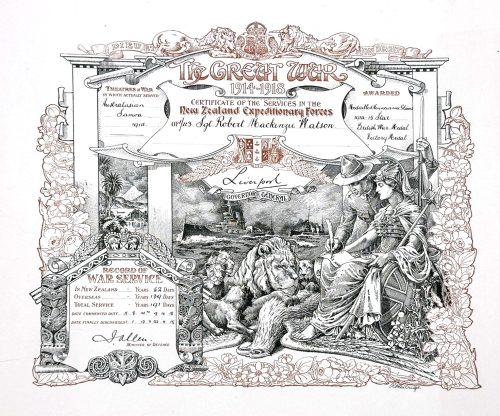
William was awarded the French honour Medaille d’Honneur en Argent in recognition of valuable services in Samoa during the first year of military occupation.
William joined up with the New Zealand army again in August 1918, at which point he was still working as a liquidator for the Imperial government. He was assigned to the 49th Reinforcements as a Private. He was transferred to the 53th Reinforcements in October 1918 but by this stage the war in Europe was coming to an end and no more New Zealand troops were being sent away. He was demobilised in late November 1918.
He was living in Auckland in 1927 and in 1944 but there is no New Zealand death record for William, suggesting he too died overseas. His family gravestone in Scotland records his death on 22 February 1977.
William’s nephew and Farquhar’s son, Farquhar Duncan Matheson, was an RNZAF bomber pilot who died in World War 2.