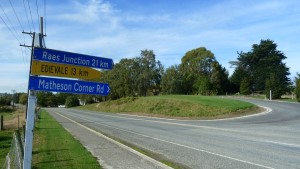
Matheson Corner Road
Crookston is a farming locality in West Otago near Heriot and Tapanui, and just over 50 km north of Gore. It takes its name from Crookston Burn in Scotland, but was earlier called McKellar’s Flat. The eponymous Mr McKellar owned the large Brooksdale run, and in 1876 14 blocks of 200 acres each were subdivided off this run and auctioned. One of the successful bidders was Norman Matheson.
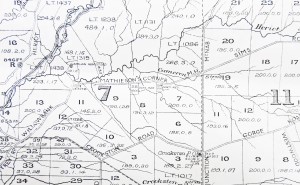
He had bid for several sections and was successful with section 20 in block 11, beating five other bidders to buy the 200 acres at £2 9s per acre, or £490 in total. This was bought under the government’s deferred payments scheme through which Crown land could be sold and payment deferred, provided conditions such as living on the land and making improvements were met. The deferred payment system was a key element of the government’s efforts to settle and improve the land. Successful bidders had to pay a 5% deposit and the remainder of the purchase price in six-monthly payments over 10 years. Provided they made those payments and spent a designated amount on improving the land, after that time they acquired ownership of the property.
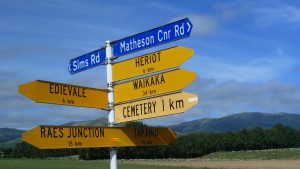
The corner between the Gore/Raes Junction Road (now State Highway 90) and a minor road became known as Matheson’s Corner, as Norman Matheson’s farm abutted both roads. The road connecting this corner and Heriot to the west became known as Matheson Corner Road.
Who was this Norman Matheson? He hailed from the Isle of Lewis in the Outer Hebrides of Scotland. According to his obituary in the Tapanui Courier he left Scotland first for North America, where he worked for the Hudson Bay Company in the fur and timber trades. He came to Otago in the 1860s and worked on a farm at Clydevale on the Clutha River, before crossing over the Blue Mountains to Tapanui where he worked in bush felling.
He successfully drew one of the Brooksdale sections, where he farmed successfully. Following a serious accident he went to hospital in Dunedin, where he died on 26 August 1899 following complications. He is buried in Dunedin’s northern cemetery.
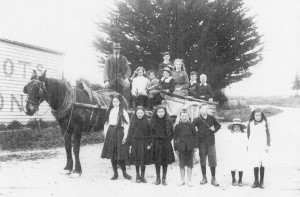
It appears from his death notice and obituary that Norman Matheson didn’t marry. He did, though, serve on the Crookston School committee for a period from 1880. The photo of the horse and cart shows the Brooksdale school ‘bus’, which traversed the roads of Tapanui and district. The photo dates from about 1910 and according to records of the West Otago Vintage Club shows Hilda Matheson third from the right on the cart and Mabel Matheson at the right of the front row, standing. What relation they are, if any, we don’t know.
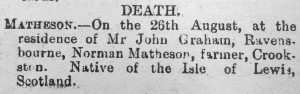
There are some interesting twists in this tale. When Norman died his death notice was published in several papers, including the Otago Witness, Otago Daily Times and Evening Star. It was accompanied by a somewhat florid poem by one Wm M Stenhouse. Who was he, and what was his connection to Norman? William MacStravick Stenhouse was a prominent medical doctor in Dunedin, a Scot like Norman. Dr Stenhouse qualified as a doctor in Glasgow and came to New Zealand as the ship’s doctor on an emigrant ship in 1875, and after travelling back and forth several times in the same capacity settled in Dunedin. His biography says that he had originally intended to follow a literary and political career, but “owing to an unfortunate accident he was deterred from doing so, and … he
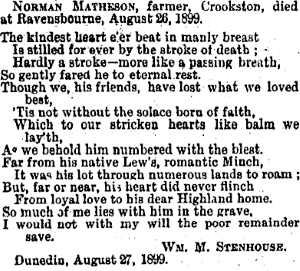
decided to study medicine”. His love for writing and poetry was expressed in the publication of several books including a collection of poems, and of course the poem he wrote on the death of Norman Matheson.
They must have been close friends. Norman was buried in Dunedin’s southern cemetery on 27 August 1899, in a plot with William Stenhouse’s sister Mary Stenhouse, who died aged 43, and his daughter Ann Stenhouse who died aged only 13. (William died in 1923 but it’s not clear where he was buried. His wife Harriet died in 1937 and her ashes were scattered.)
Here’s the mystery. Also in the plot with Norman Matheson and William Stenhouse’s daughter and sister is ‘Baby Matheson’, who died three days before Norman was buried, on 24 August 1899. In that year the deaths of only two Matheson children under five years old were recorded in New Zealand. One, aged two, was a relative of mine who died in Auckland. The other was Margaret Matheson, aged seven weeks. Is this the ‘Baby Matheson’ who is buried with Norman? If so, what was their relationship?
Finding out the origin of the name of Matheson’s Corner Road has been an interesting quest, and visiting the corner and the road a quest on a holiday in Otago. I’ve been greatly helped by Wilma Brock, a volunteer at the West Otago Vintage Club in Tapanui, which acts as the district’s local museum. Wilma has provided useful local information, including the crucial plan showing where Norman Matheson’s section was located. Wilma has a Matheson connection herself, as her aunt Cora McLean married Murray Matheson, and was a New Zealand small-bore rifle champion in the 1950s and 1960s. The Hocken Library in Dunedin kindly copied Norman Matheson’s obituary and death notice from the Tapanui Courier, which isn’t yet on-line in PapersPast.